

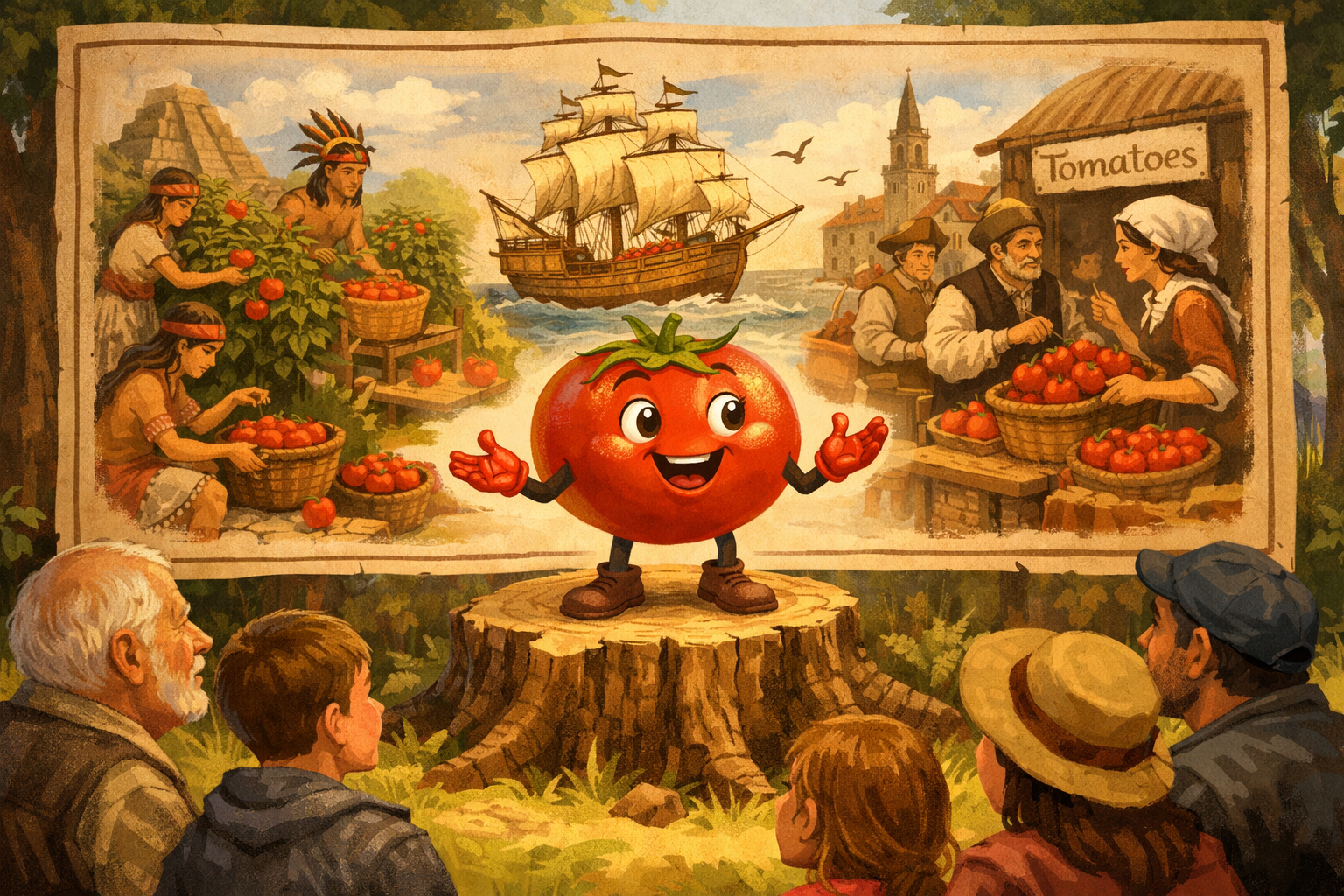
I am a tomato.
Yes, you didn’t hear wrong. I am a tomato. When my price goes up, I become a “national issue” on television; when it goes down, I quietly end up in your salad. And every now and then this happens, you look at my label and sigh, then you talk as if you are not buying me but “the price of tomatoes.” Sometimes you do not see me as a food item but as a moral test. As if I were a red litmus paper that brings out the good and the bad inside people.
In fact, I am an ordinary agricultural product that reaches the shelves at the end of a long journey you do not see. I am ordinary; but my story is not ordinary. Because my story is the story of risk, cost, division of labor, profit, knowledge, and human psychology. And this story is rewritten every day: one day the rain is late, one day hail hits, one day diesel prices rise, one day demand suddenly jumps. While you stop by the market on your way home and ask, “How much are tomatoes today?”, I am already carrying ten different decisions, ten different risks, ten different expenses on my back.
From history to the present
First, a small history lesson. I was once branded as “poisonous.” In Europe, in my earliest days, instead of being put on the table, I became an ornamental plant in gardens. Some of my relatives really were toxic; but what determined which of us was harmful and which was edible was not a committee decision. People tried, failed, sorted, improved, and developed me. The bad ones were eliminated; the good ones were selected. Behind my becoming “edible” lay not command-and-control but trial and error, curiosity, and thousands of small observations from everyday life. Knowledge did not descend from a center; it came out of life.
The process that brings me to your table today works with the same logic: someone takes risk, someone bears cost, someone works, someone carries the shrink (the loss), someone builds coordination. And for this chain to run, everyone must survive. The name of survival is, most of the time, profit. Faces sour when profit is mentioned; but when there is no profit and the shelves become empty, those same faces sour even more. I call this “profit phobia, scarcity therapy.” Sometimes a person’s medicine is thought; but people who do not like thinking choose scarcity as a kind of teacher.
When I was on my branch, I was romantic. The moment I was picked, I began to become economic.
Seeds are bought. Fertilizer is bought. Pesticide is bought. Water and electricity are spent for irrigation. The tractor runs; diesel burns. Workers arrive; they carry crates, hoe, and harvest. When the farmer makes an investment decision, he also signs a contract with the sky: a contract that begins with, “In case frost hits, hail falls, disease spreads, floodwater comes…” The signature under that contract is renewed every year. Because agricultural life is not only labor; it is a contract signed with uncertainty.
But the real issue is the gap between where I am produced and where I am consumed. The producer in the field does not always have direct access to the city. Not every farmer has a cold-storage facility, a truck fleet, a wholesale-market entry card, or contracts with big supermarket chains. In most cases—especially at harvest time—there is a need for cash: paying workers, fertilizer debt, diesel debt… So every farmer wants to turn the crop into money quickly. This is exactly where the actor you call the intermediary appears. You think, “If there were no intermediary everything would be cheaper,” but the intermediary is sometimes not only an “intermediary”; at the same time, he is a financier, a logistician, a warehouse operator, and a risk taker.
Let’s say I was sold in the field for 6 lira. The first collector who buys me (in some places called a commission agent, in some places a trader, in some places a wholesaler) takes me. This person brings crates to remove me from the field, organizes workers, arranges a truck. Sometimes he goes around several fields in a single day; sometimes he makes me wait until he has gathered enough quantity within one or two days. Even this waiting is costly: the sun hits, humidity changes, the risk of cracking increases. And let me tell you the truth: waiting in the field is not romantic. I like waiting on my branch; waiting in a crate feels like punishment.
Then comes the small warehouse. In the small warehouse, sorting is done. Those that look “nice,” like me, are separated; those that look “a bit tired” are left behind. Because you only see the “nice” one on the shelf, you do not see the cost of sorting. Yet sorting is essentially a quality-control activity. Quality control means labor. Labor means cost.
A portion of the sorted product shrinks (loss). Shrink is sometimes natural decay, sometimes crushing, sometimes selectiveness. The moment you say, “I want a flawless tomato,” you increase the shrink rate. When the shrink rate increases, the cost of the tomatoes that survive rises. This sentence may sound bitter, but it is true: the demand for flawlessness produces cost.
After the small warehouse I pass to a bigger warehouse. In this bigger warehouse, more product accumulates. It accumulates because transport, especially intercity transport, needs scale. It is expensive to set off with a half-loaded truck. The accumulated product is, on the one hand, seen as “stock,” but on the other hand it is “transport efficiency.” So the aim of waiting is often not “to sell at a high price” but “to transport at a reasonable cost.” Of course, some foresee prices will rise and wait. You get angry at that too. But you often forget the risk of that waiting: if prices do not rise, they lose. If the product spoils, they lose. Waiting is not a free game.
Then the truck journey begins. I am filled into crates. Stacked. Back to back. I was the one being crushed in the bottom crate. My cousins on top were aristocrats; I was a lower-class tomato. Life on the bottom layer of a crate is harsh: weight above you, rot next to you, a road ahead, and behind you an official shouting, “Hurry up!”
The truck shakes for 600 kilometers. The road is not only distance; the road is cost. Diesel burned. The driver’s labor, insurance, rest time, maintenance, tires, depreciation… highway tolls, bridge fees… All of these are the lines written onto me before you tell the cashier, “What is this!” Moreover, the truck also has an opportunity cost: while the truck is doing this job, it cannot do another job. You assume “this transport job will happen anyway,” but a truck’s days are limited, a driver’s hours are limited. A limited resource produces cost.
We arrived in Istanbul. At this point I enter a new world: the wholesale market. The wholesale market is like the vascular system of fruit and vegetables in a city. The wholesale market itself has operating costs: allocation of space, rent, labor, security, cleaning, taxes and fees. Products turn fast in the wholesale market; but the faster they turn, the higher the risk of shrinking is. Because speed requires attention. Attention requires labor. Labor requires cost.
After the wholesale market, some products go to the depots of big chain supermarkets. These depots have a cold chain. The cold chain is not merely a “luxury”; sometimes it is “the brake on rotting.” Cooling consumes energy. When energy becomes expensive, the cold chain becomes expensive. When the cold chain becomes expensive, the cost is reflected in the product price. Sometimes the answer to “Why are tomatoes expensive?” is not in the tomato itself, but in the electricity bill that keeps it cool.
Some products go to neighborhood markets, greengrocers, small retailers. And there, costs do not end: stall rent, daily spot fees, staff, bags, spoilage… You touch a tomato at the market and say, “hmmm.” Your touch itself creates cost: every touch, every squeeze, every “let me see” tires a tomato a little more. A tired tomato spoils sooner. A spoiled tomato becomes shrink. Shrink raises the price. So my fate in the market is sometimes in your fingertips.
Meanwhile, what we call demand is not a fixed stone; it is wavy. Demand rises before holidays. When schools open, household consumption changes. You see a menemen scene in a TV series, and the next day there is a “menemen crisis.” (I’m joking… but not completely.) When demand rises, the price rises. When demand falls, the price falls. What you call “morality” is, most of the time, a “wave.”
And there is the effect of weather events. Hail hits, production falls. A greenhouse floods, the crop is gone. Disease spreads, yield drops. If there is too much rain, cracking increases. If there is too much heat, softening increases. In short, I am a product that talks with the weather. The price of a product that deals with the weather is as changeable as the weather. Since you do not get angry at the weather, you get angry at me. I am not as powerful as the weather; it is easier to take it out on me.
Finally, Istanbul. Shelf. Light. Label: 25 lira.
At exactly that moment, ideology rains down on me. I suddenly stop being a “vegetable” and become a symbol of “social justice.” My price is counted, on the one hand, as proof of “the high cost of living,” and on the other hand as a document of “merchant immorality.” Meanwhile I stand silently on the shelf, under my label, and I say to myself: “If only you gave me a microphone so I could speak.”
And one day, you did.
Right here—where my price turns into a label—you usually look for “one single cause.” Because the human mind likes simple stories. “This happened, so it is expensive.” Yet I am not a single-cause thing; I am an equation in which many causes are stacked on top of each other. What makes me expensive is sometimes diesel, sometimes hail, sometimes labor, sometimes just the season.
Speaking of seasons: there is my summer-tomato state and my winter “greenhouse child” state. In summer, the sun is more generous; production increases; costs loosen relatively; and I often become cheaper. In winter, heating, lighting, cover, maintenance, disease risk, and energy cost increase.
A winter tomato is not, as you think, “the winter version of the same tomato”; it is a labor-intensive product that has survived under harder conditions. You want the same quality, the same look, the same continuity; but you do not want the same cost. This is where the argument begins.
And there is another truth the urban eye misses: my price sometimes rises, but the farmer does not become rich. Because the farmer often hears the price signal late. On the day the price rises, the producer may already have sold his crop. Or when the price rises, the producer may have no product in the field because hail hit. So the logic “tomatoes are expensive → the farmer got rich” is not always correct. Sometimes the opposite is true: if tomatoes are expensive, something went wrong; and the bill of what went wrong often comes out of the producer first.
At this point let me open a parenthesis and return to the “intermediary” issue. Hating the intermediary is easy, because the intermediary is in front of your eyes. The farmer is far away; the truck is far away; the warehouse is far away. But the intermediary is a face in the city. When you see a face, blaming becomes easier. Yet the person you call the intermediary often does these jobs: he combines the product (collects), separates quality (grades), balances the market by spreading over time (holds), builds logistics (moves), takes the spoilage risk (carries shrink), organizes sales (distributes). Each of these activities is costly. If you call all of it “immorality,” one day there will be no one left doing these activities. That day tomatoes do not become cheap; they simply become unavailable.
Once there were people who dreamed of an “intermediary-free economy.” “Let the farmer sell directly!” they said. Nice idea. But can the farmer send a truck from Antalya to Istanbul every day? Can he build warehouses? Can he invest in the cold chain? Can he go around thousands of retailers in Istanbul one by one and collect payment? If he does these, the farmer stops being a farmer and becomes a logistician, warehouse operator, marketer, collector. Some can do this; but not everyone can. Division of labor exists for exactly this reason: so not everyone does every job, and each job is done in the best way.
And there is this strange expectation: you want tomatoes to be there all the time, and you also want the price to never change. “Every day, every hour, everywhere, tomatoes at the same price.” This is the comfort demand of modern life. Comfort produces cost. To make something continuously accessible, you hold stock, build warehouses, plan transport. This system has a cost. If you want “continuity,” you must accept that the price reflects the “continuity cost.” Otherwise, continuity will one day inevitably break.
Your relationship with the tomato also carries a strange duality: on the one hand you say “let it be very cheap,” on the other hand you say “let it be the best.” There is often tension between very cheap and the very best. Wanting the best tomato while wanting the cheapest price is, in a sense, a demand for “free perfection.” There is no free perfection. If there were, someone would interpret it as “hoarding,” too.
In short, my price does not fit into a single sentence. My price is the result of thousands of small nodes in a network. When you do not see the network, only the label is visible. When the label is visible, anger becomes visible. When anger is visible, a TV program is made.
And there is also the outside world. Sometimes there is abundance in one region and scarcity in another. Sometimes exports become attractive; sometimes imports come onto the agenda. Exchange-rate moves, freight costs, waiting at the border… even these touch my price indirectly. You say, “Tomatoes are local; what do we care about the exchange rate?” But I am transported on roads, I consume energy, I go into packaging, sometimes I am fed by fertilizer and chemicals. If part of these inputs depends on abroad, exchange-rate volatility echoes on me too. A tomato is not “just a tomato”; it is the combination of many inputs.
In the television debate
So the night of that program in which I could reach a microphone came.
9:00 p.m. A debate program on a news TV channel. The lower ticker: “WHY ARE TOMATOES 25 LIRA?” The control room deliberately chose red text: red is my color, but also the color of alarm. “Attention! Tomato!”
The studio set is also classic: a consumer representative, a “free-market critic,” and an economic commentator who likes speaking with charts. The host makes his face serious; seriousness brings ratings on screen. When the screen becomes serious, it is assumed that reality has become serious too.
The consumer representative begins:
“Citizens cannot buy tomatoes. Isn’t there profiteering here?”
The free-market critic gets excited:
“How does a tomato bought for 6 lira in the field become 25 lira in the market? This is exploitation! The chain of intermediaries is crushing the citizen!”
The chart economist draws circles on the screen with his hand:
“We can explain the difference with chain margins: logistics, storage, shrink…”
The host asks in a dramatic voice:
“But is there not a moral dimension to this?”
At that moment, as a tomato on the shelf, I suddenly feel like the material of a morality lesson. Being the material of a morality lesson is not easy. Because material cannot speak. Material cannot defend itself. Material cannot say “one moment.”
But I did.
I called the control room. They picked up the phone. The host smiled:
“Apparently we have a tomato on the line. Go ahead?”
“Good evening,” I said. “I am a tomato.”
Laughter in the studio… Laughter is good; but sometimes it completely blocks thinking, or at least delays it.
“Look,” I said, “my price is not a certificate of guilt. My price is the summary of that day’s supply, demand, risk, and costs. If production fell, if diesel rose, if storage costs increased, if shrink grew, I rise too. I am not a being that lowers its price out of shame.”
The consumer representative asked, with good intentions:
“But people are really struggling. What will we do?”
“That question matters,” I said. “But do not look for the answer in me. Income policy is another topic. Support mechanisms, social assistance, tax arrangements… these can be discussed. But suppressing my price by decree does not permanently relieve people; it only removes me from the shelves.”
The critic immediately jumped in:
“What if we set a ceiling price? Say, 15 lira!”
I smiled (again, metaphorically) and answered:
“Try it. You might succeed for a week. Then you will watch me vanish. Because if you cut the signal, you do not remove the problem; you remove the information. A ceiling price either pushes quality down, or pushes supply away, or creates a black market. Tomatoes do not like to be heroes in a price-control drama.”
The economist tried to add:
“Price is information…”
“And that,” I said, “is exactly what I am trying to tell you.”
Then I turned to the moral question:
“If you want to talk about morality, talk about waste too. Talk about the tons of food thrown away. Talk about the hands that squeeze tomatoes for pleasure and then complain about shrink. Talk about the expectation of ‘the best’ at ‘the cheapest’ price. Morality is not only about the trader; morality is also about the consumer and about society.”
The host attempted a closing:
“So, dear tomato, what is your final message?”
As we come to the close, I added one more sentence. Because my concern is not to tell you a comfortable tale like ‘the market solves everything.’ My concern is to break the habit of seeing price as an enemy. “Price,” I said, “is a news bulletin. It shouts: ‘There is scarcity here,’ ‘Costs are rising here,’ ‘Risk is increasing here.’ If you silence the news, the event does not disappear; it only remains in the dark.” Then I produced a list of suggestions; tomatoes sometimes have to-do lists too:
“If productivity in production rises, I become cheaper. If transport becomes efficient, I become cheaper. If storage technology improves, shrink falls, I become cheaper. If competition rises, margins thin, I become cheaper. If waste declines, I become cheaper. But none of this happens by ‘getting angry at the label.’”
And one last complaint:
“When you label me as ‘excessive,’ you are actually labeling labor you do not see. The driver’s lost sleep, the worker’s overtime, the warehouseman’s electricity, the farmer’s risk… And then you ask, ‘Why does no one want to produce?’ Sometimes the answer is hidden in you.” The ticker changed:
“Tomato in the studio: ‘Price is information.’”
The program ended. I got off the chair. The staff put me back into a crate. The cameras moved on to another agenda.
What the price says
While leaving the studio, in the corridor, a cleaning worker looked at me, smiled, and whispered: “I wish everyone spoke as clearly as you do.”
And I said to myself, “I wish everyone saw a little before speaking.” Because my whole concern is not to teach you economics; it is to make invisible labor visible. You do not have to love the price. But do not judge it without listening to the story it tells. Behind a label there is often a map of the whole country’s logistics. And yes… the one crushed in the bottom crate was still me.
Inspired by Leonard Read’s piece: I, Pencil.